Monday, March 7, 2016

Sock Pocket Couture for Fashion-Forward Adults


Sock pockets in action

For an introduction to the concept of sock pockets see the previous post, An "Aha" Sewing Moment: Sock Pockets. In that post I pointed out that sock pockets solve two problems: lost socks and lack of pockets. In the course of adapting the concept to couture for savvy adults who don't give a crap if they look like victims of static cling, I have tackled a third problem: socks with worn heels. We all have them — favorite socks that have become so worn at the back of the heel from shoes rubbing that they become an embarrassment in the security line at the airport. And yet we don't want to throw them away. Voila — sock pockets!

How-to details

As explained in the last sock pocket post, when using an adult sock you will want to stitch horizontally across the sock somewhere that makes sense in terms of creating a functional pocket. See the gray sock above for an example. If you don't do this, whatever you put in the pocket will work its way down into the toe and be impossible to get back out.

The new innovation is illustrated by the red sock above. This was a sock with a badly worn heel. The sock was cut off at the ankle, inserted into the large pocket on the shirt, and then the cut bottom of the sock was stitched horizontally inside the shirt pocket (only to the back of the shirt pocket, leaving the original pocket free and fully functional) to create the sock pocket bottom. With this shirt, this also solved the problem of large, floppy, non-functional pockets. Before, if you tried to stash a pair of glasses in the original pocket they would fall to one side, get snagged, and be a hassle to remove. Now, with the addition of a snug sock pocket, the glasses are easily accessible while the original large pocket remains free to store other things.

How-to details

Following the procedure outlined above, here a sock with a worn heel has been cut at the ankle and then again at the arch of the foot. The worn heel section was discarded. The top section of the sock is used to create a snug pocket-within-a-pocket, while the toe of the sock forms another little pocket. See close-up photos below.

Sock pocket inside original pocket

Pocket from toe of sock

Sock pocket inside of original pocket

Sunday, March 6, 2016

An "Aha" Sewing Moment: Sock Pockets

We all have a sock drawer that includes several lone socks. The missing halves of these pairs entered the laundering process and went on a walkabout, joining the mysterious pilgrimage of lost socks. We keep the lonely remaining sock because we hope in vain that the other half will somehow find its way back to us, even though that has never happened.

An artful solution to lost socks

This sewing/mending/upcycle solution addresses two common problems: lost socks and lack of pockets. Combine the two and you have sock pockets. 

Sock pockets in action

The children's shirts shown here were purchased for a few dollars each from a thrift store and were the focus of this proof-of-concept stage. In the next post I will move the sock pocket concept into adult couture. The two children's shirts shown here do utilize lone sole-survivors from my sock drawer but also include a few children's socks I picked up dirt cheap in Chinatown because I have no four-year-olds running around my house and was too impatient to launch into this project to track a child down and rummage through his or her sock drawer.

How-to close-up

With the genuine orphan sock above, I realized that anything put in the opening of the pocket would fall down into the toe and become inaccessible unless I created a pocket bottom by stitching across the base of the ribbing, as shown above.

Detail of sock pocket

For the much smaller children's socks no added pocket bottom was necessary. As a bonus, I realized the small flexible cuff on the child's sock serves as an added security measure to keep contents securely inside.

Close-up

I stitched the blue sock above so that half of the sock extends below the hem of the shirt, adding to that "just tumbled out of the laundry" look.

Shirt back

The socks on the back of the shirt aren't meant to be functional pockets (experience has taught me that it is extremely uncomfortable to sit back against a full pocket). Instead they add to that tumbled, lost sock, static cling look that I am going for here.

A second proof-of-concept children's shirt is shown below.

Shirt front: sock pockets loaded with toys, shells, and drawing pens

Detail

Detail: Perfect for beach combing

Detail how-to

Shirt back

Stay tuned for the adult version of the sock pocket in action. Meanwhile, here are snapshots of girls in sock shirts below.

Front view

Back view

Saturday, February 27, 2016

Ecofairies: Sixth Extinction Children's Fantasy Wear


Ecofairy One: Front

Ecofairy One: Back

A set of fairy vests for the generation that is going to inherit this amazing planet of ours along with all of its ills. The basic vest pattern comes utterly free from Zsazsazilet (use an online translation site to figure out what the pattern says). I had to make a few measurement adjustments and also cut the front of each vest in a wavy pattern for whimsical interest. The basic vest shell is made of felt. All embellishments are recycled materials.

Ecofairy Two: Front

Materials on the front of the vest include recycled ribbon, pocket from thrift store cargo pants, old typewriter keys, recycled vintage buttons and rosettes, and a removable Recycled Ribbon Award embellished with an old bottle cap (follow that link to an earlier post for how-to instructions). 

Ecofairy Two: Back

The back of each vest features an image of a passenger pigeon printed onto transfer paper and then ironed onto a scrap of fabric. The passenger pigeon went extinct just over a hundred years ago, a perfect symbol for the Sixth Extinction that underscores the urgency of an ecofairy's mission. The wings are tulle. From past experience I've learned that free-form tulle wings hold their airy, fluffy nature remarkably well. 

Close-up, front

Old typewriter keys let the world know exactly what this fairy is all about.

Close-up, front

Removable award pin made from recycled ribbon features an old smashed bottle cap found on the street. The surrounding rosettes and other ribbons came from the last hour of the Oakland Museum White Elephant Sale when you get everything you can stuff into a bag for a dollar.

Close-up, back

Passenger pigeon patch on back of each vest reminds us that we are now in the midst of a mass species extinction, the sixth our planet has suffered and one caused entirely by humans (the last, caused by a meteor, wiped out the dinosaurs).

Close-up, back

A cone of felt at the base of the tulle wings, cut and stitched free-form, hides the stitching that secures the wings to the vest and keeps the wings slightly aloft.

And here are the fairies, ready for eco-action.

Ecofairy One

Ecofairy Two taking a walk with a serval at the zoo

Sunday, February 21, 2016

Patching Three Ways to Cover Stains and Relieve Boredom


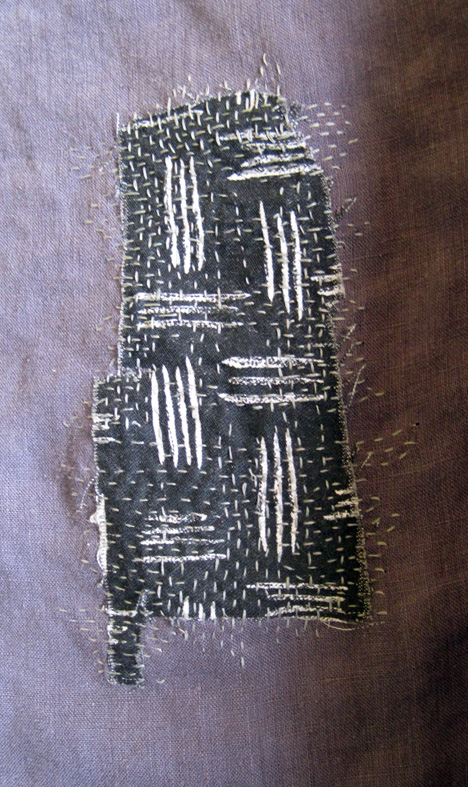
Boro patching with sashiko stitching

Surely I cannot be the only one who manages to drip a blob of something or other down the front of whatever I'm wearing, seemingly every single time I dine out. Unfortunately, those something-or-other blobs don't blend well with my love of natural fabrics and natural dyes. In my experience, once a blob hits cotton or linen it will remain there as an unsightly discolored stain no matter what cleaning methods I employ. Happily, I have learned to just patch those stains into oblivion in a variety of ways (see Mend Writing for one of those techniques not covered in this post).

NOTE: All three shirts in this post were thrift store scores in pristine condition before I waltzed them around in my messy world.

Stain removed with boro patch

I believe the culprit here was a bowl of mussels in anise broth. The blob smack in the middle of my chest remained a discolored stain after laundering.

Boro patch with sashimi stitching

To cover this unsightly stain I used a scrap of Japanese fabric and the Japanese technique of boro patching, employing sashiko stitching. I like the end result better than the original shirt, which was a bit boring.

Circle patching: a cure for boredom

Speaking of boredom, the patching job shown in the photo above is a response to an utterly boring Flax thrift store shirt. The solution: marrying it with another thrift store shirt. I cut up a $1 equally boring man's shirt, created a bunch of circle patches, and stitched them on.

Circle patch

To create circle patches, use a jar lid to draw a series of circles on a piece of cardboard and then cut the circles out. Place a cardboard circle in the center of a roughly circular piece of fabric, and then iron the edges over the cardboard template, being careful to keep your fingers out of harm's way. Slide the cardboard out and you've got a perfect turned circle ready for patching. I am keeping a few circles in reserve since it is only a matter of time before I manage to drop something down the front of this shirt.

Creating circle patches

From blob to political statement

Segueing back to unsightly blobs, here we have another thrift store Flax shirt. I have no recollection of what caused this particular stain, but post-laundering the problem was evident. This time around I used a leftover patch from my Sixth Extinction series. Follow that link if you want to see more Sixth Extinction couture and furniture and learn about our current eco-crisis and the 100th anniversary of the extinction of the passenger pigeon. 

Passenger pigeon patch and vintage buttons

This photo of dead passenger pigeon specimens in a museum collection was printed onto photo transfer paper, ironed onto a scrap of cotton fabric, and then used as a patch. Note that I have also switched out the shirt's original buttons with a set of vintage buttons. 


Thursday, February 18, 2016

Apron Headboard: Souvenir Decor


Apron headboard, daytime

I have a long-standing fascination with aprons as iconic societal objects. In my Science Apron series I focused on vintage aprons from the U.S. embroidered with musings about a range of scientific theories and discoveries, combining a love of textiles with ongoing documentation work for science museums.

Then, during my travels, I began to notice what an integral part aprons still play in so many cultures around the world and started visiting local markets and artisans to collect a few aprons along the way. They remained in a drawer until I thought of this headboard idea. The embroidered aprons at the bottom are what you will see many women wearing in Oaxaca. The one at the top, featuring a bunch of nifty pockets (some zippered and hidden) are what female street vendors wear in Nicaragua.

Apron headboard, late afternoon

The souvenir decor here doesn't stop with the aprons. In the top picture above you will also see embroidered pillowcases from San Cristobal de las Casas and a tiled mirror from Puebla, as well as a couple of painted wood alebrije lizards from Oaxaca. And yes, that is a fish dangling from the ceiling. For info about some of the other objects seen in these photos, including lampshade and quilted bedspreads see the Decor category on this blog.
Friday, February 5, 2016

Fooling Around with Flotsam and Jetsam


Waiting around for creative inspiration to strike can be a depressing business and, on occasion, a one-way trip to a dark night of the soul. I have learned to fiddle in the interim, and as you can see by my last few posts I have been fiddling a lot lately.

Dog Watch

Here I am fiddling with a rusted old bottle cap found in the parking lot at Oakland's 7th Street Terminal park, combined with scraps of fabric from my overflowing fabric bins. While technically both flotsam and jetsam are maritime-related and come from ships, the beer bottle cap was found at the site of one of the largest shipping container ports in the world so I'm calling it jetsam, though it was probably jettisoned from a car. See the distinction between flotsam and jetsam as described by Wikipedia:

Flotsam and jetsam are terms that describe two types of marine debris associated with vessels. Flotsam is defined as debris in the water that was not deliberately thrown overboard, often as a result from a shipwreck or accident. Jetsam describes debris that was deliberately thrown overboard by a crew of a ship in distress, most often to lighten the ship's load. The word flotsam derives from the French word floter, to float. Jetsam is a shortened word for jettison.

Front

Japanese-style sashiko stitching adds a little interest to the fabric band.

Back

So now I've got a beer bottle cap dog watch I can wear as I head out to look for something else to fiddle around with.


Friday, January 29, 2016

Tsukumogami: Objects with Souls


The Wandering Glove

According to Japanese folklore, objects that are over 100 years old become alive and self-aware and often plague or play tricks on humans. These objects are known as Tsukumogami. Japanese artists have created drawings and paintings of the more famous Tsukumogami, like the umbrella below.

A two-legged umbrella Tsukumogami from the "Hyakki Yagyo Zumaki" by Enshin Kanō

We are all free to interpret ancient folklore any way we please, and after finding a small red glove on the floor of the number 1R AC Transit bus, I decided that lost objects are another form of Tsukumogami. Simply by virtue of being lost and out in the world on their own they gain a soul. It was a rainy day and the glove was abandoned in a little puddle of muddy water. I tucked it into my pack, brought it home and washed it, and proceeded to use a little stitchery to bring its inner soul to light.

Close-up of face

I had assumed the glove's animating spirit would be mischievous and a little mean (having been abandoned in a mud puddle on a bus floor), but what emerged was a sort of silly, slap-happy fellow.

Human hair sprouting from the fingertips

The addition of tufts of human hair (my own) sprouting from the fingers served to lend the glove Tsukumogami a little gravitas.

Ready to head out into the world

What to do with the newborn Tsukumogami? I decided to put it back where I had found it, where it had first gained its wandering soul: on the AC Transit 1R bus.

Riding the 1R

Who knows where it will wander now, what pranks will be played, and what legends will grow around the tale of the wandering Tsukumogami glove. 


Related Posts with Thumbnails