Showing posts with label god. Show all posts

Saturday, November 25, 2023

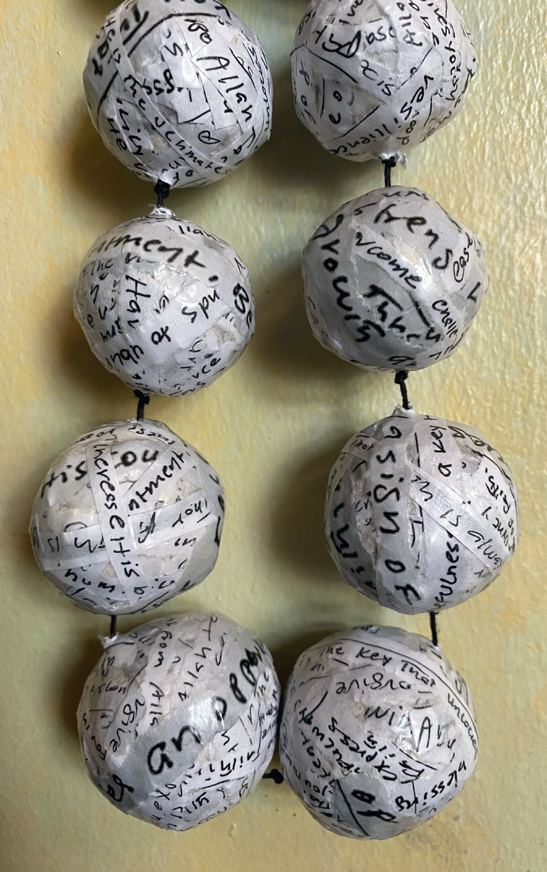
Peace, Love and Understanding: Papier Mâché Beads


 A week after the Hamas attack on Israel with tensions running high, global tension rising, and people finding even more reasons to fight the multi-front reality wars, I was in a Lyft car on my way to an 8-day Krishnamurti Retreat in Ojai. My Lyft driver, Abdulcadir, was friendly and curious and after questioning me about my destination and about Krishnamurti, he shared that he had his own daily spiritual practice. Every day he would write down a spiritual thought or principle, carry it with him, and periodically meditate on the principle throughout the day. We agreed that the basic ideas of kindness, gratitude and acceptance are common to all religions and spiritual belief systems, and were mutually baffled why the human species keeps turning on itself.

He reached for an old envelope on the front passenger seat that he used to record spiritual principles for his daily practice and handed it back to me, I asked if I could photograph it and he happily agreed.

Original envelope front


Envelope back

I have worked with paper mâché beads in the past to process life events, and have found it to be a deeply satisfying, slow meditative process over a period of days or weeks. The process of making these beads is outlined in an earlier post, Funerary Art: Souvenirs from the Bardo. When I returned home after the retreat, I reproduced scaled printouts of Abducadir's envelope to produce this beaded strand while the conflict in Gaza escalated.


It is hard to make sense of the world and of humanity itself in these troubled times. I do it with my hands. It helps. Talk to strangers. Be kind. Make stuff. 

Monday, March 1, 2021

Funerary Art: Souvenirs from the Bardo

First Journey: Bardo Beads


Bardo Beads

My lifelong friend and traveling companion of 51 years left the planet on January 12. In Tibetan Buddhism they believe the soul passes from death into the bardo state - a realm I envision as a jungle or forest with a lot of confusing adventures in store. The goal in the bardo is to strip away the illusions, fears, and misbegotten ideas about reality and to see reality stripped bare, to see the light of raw being and to go for it. Meanwhile, all of your old fears and ideas and character defects appear to you as hallucinations, attempting to trick you into buying into the same old burdensome reality you just escaped in your last life.

The bardo journey lasts for 49 days, after which you are reborn (or, if you succeeded in the bardo, you achieve enlightenment and a pure state). My companion's stay in the bardo ends today. During this final trip together (or almost final, as you will see below), I fashioned some artifacts that are, in effect, bardo souvenirs.

The bardo beads

The first project was to make papier mâché beads. Source materials included old notebooks from our global travel adventures and birding expeditions, old travel documents, and letters, including a vintage aerogram sent by me in Nairobi to him on the Serengetti back in 1968, just after we had first met.

Source materials

The 
papier mâché technique I used was one I learned in San Cristobal de las Casas from a master of puppetry, Licha Matita. Begin with a clay base and roll it into a ball. For the first layer, cover the clay ball in lotion (any hand lotion will do) and use more lotion to cover the ball with tiny scraps of paper, all the same color, to create your first layer. This will make it very easy to remove the clay ball in the final steps.

Clay innards revealed in final step

You then want to build up six to seven layers of papier mâché, using a standard paste of half water and half flour (thinned as needed for easy application). Using tiny scraps of paper allows you to retain the curve of the ball easily. Most importantly, use a different color paper for each layer. This allows you to easily see what you have covered and what you have not. Otherwise you will get hopelessly muddled, which is easy to do in the bardo. I used the good luck paper the Chinese burn for the dead, which you can find in any Chinatown, and which seemed very appropriate for bardo beads, alternating that layer with layers from notebooks pages, letters, and other personal ephemera.

Layers of letters and notes

Layers of Chinese good luck paper

This was slow, patient, meditative work, and I sometimes chanted the heart sutra while working. A few days ago I knew I was done. The final step was to cut the balls open with an exacto knife, scoop out the clay core, and then seal the ball back together with a final layer of papier mâché.


Second Journey: Bardo Bag

Half-way through the meditative bead work, I suddenly got a call that the Neptune Society had the ashes ready and I needed to receive them. The idea momentarily horrified me. The whole point of the bardo process is to let go of everything, and now the earthly remains were boomeranging back. After giving myself a day or two to think it over, I decided to fashion a bardo bag - a little pouch I could use to take a portion of the ashes along with me on all future travels, and distribute them to the wind and sea around the world, in the spirit of letting go. I used a length of exquisitely hand-embroidered Chinese trim, a spiral button from Portobello Road in London, and a piece of horn from who knows where to create this little traveling bardo bag. A sealable plastic snack bag containing ashes can fit neatly inside. 

Bardo traveling bag


Back of bag


This was all a deeply satisfying process, and it is being shared here with love in hopes that, when the time arises, it may offer you ideas about how to process loss and grief.

Interested in learning more about the bardo and the heart sutra? Here are two good links:


Tuesday, February 25, 2020

Wound Man Talisman #3


Wound Man: He won't protect you, but he knows how you feel.

Apparently I was not quite done with Wound Man (click here to see the two earlier versions and the back story regarding the history of this figure and image source). This version relies heavily on links with Oaxaca and San Cristobal de las Casas. Materials include milagros (metal charms depicting the limb or body part or problem you would like to have miraculously removed by a deity) and dried peas from a necklace made in San Cristobal. Inside the little bottle is liquid and tiny stones from a magic packet purchased in my favorite aisle in the Oaxaca mercadeo, where the stuff for creating wonders and magic is sold. Both stones and liquid are promoted as "strong magic."

"Strong magic" stones and liquid.

The reverse features hand printing on a scrap of flower-pounded fabric.

Back of talisman

And the words? I saw them on a sign while I was riding by on a bus, and am simply passing the message along.

Monday, February 10, 2020

Wound Man: A useful little talisman for people who seem to be falling apart


There are times in this life when the "slings and arrows of outrageous fortune" seem a bit much. I made these talismans for those times. I was inspired by "wound man" - a figure that appears, in various depictions, in all medieval medical textbooks. Wound man illustrates just about every injury known to medicine at that time that might befall an unlucky human being. Note the animals biting his feet, the assortment of weapons, even buboes near the groin from the plague.

Talisman one: front

Talisman one: back

These pieces employ iron-on photo transfer to cloth, broken jewelry and beads, eco-printed leaves on cotton, hand-stamped lettering, and lots of stitching. Talisman two (below) also incorporates a vintage tassel and glass beads.

I saw the phrase "expect no mercy" while looking out the window on a bus, and thought it would be apt for the back of the talisman. Go ahead and pray, but that rat bite is probably going to get infected and kill you anyway.

Talisman two: front

Talisman two: close-up

Talisman two: back

If you would like to learn more about wound man and see more versions of him, head on over to the marvelous Public Domain Review. And be careful out there!


Monday, June 27, 2016

Ex-Voto for the Miracle of a Kind Tree


Embroidered ex voto

I have been inspired in the past by Mexican retablos - folk-art images painted on tin or wood thanking Catholic holy figures for miracles received - and by the embroidered version of these ex-votos (offerings of gratitude), from San Miguel de Allende called milagros. See earlier work I've done along these lines by following this link: Ex-Votos.

Recently, while in Chiapas, I received via email the details of a miracle experienced by a little girl I know on her seventh birthday. According to her account, she was climbing a tree when she slipped and thought she was "falling to her death." The tree reached out its arms and saved her. A companion who witnessed the event testified, "I knew it was a peaceful tree."

Thus this embroidered retablo, recounting the event and offering thanks to the tree. The words on the pillow say: "Many thanks to the kind tree for opening its branches and saving me from falling to my death." 

Close-up detail

Close-up detail

And here is the little girl who was saved by the tree, with her embroidered ex voto pillow.

Still alive, thanks to a peaceful tree

Friday, January 29, 2016

Tsukumogami: Objects with Souls


The Wandering Glove

According to Japanese folklore, objects that are over 100 years old become alive and self-aware and often plague or play tricks on humans. These objects are known as Tsukumogami. Japanese artists have created drawings and paintings of the more famous Tsukumogami, like the umbrella below.

A two-legged umbrella Tsukumogami from the "Hyakki Yagyo Zumaki" by Enshin Kanō

We are all free to interpret ancient folklore any way we please, and after finding a small red glove on the floor of the number 1R AC Transit bus, I decided that lost objects are another form of Tsukumogami. Simply by virtue of being lost and out in the world on their own they gain a soul. It was a rainy day and the glove was abandoned in a little puddle of muddy water. I tucked it into my pack, brought it home and washed it, and proceeded to use a little stitchery to bring its inner soul to light.

Close-up of face

I had assumed the glove's animating spirit would be mischievous and a little mean (having been abandoned in a mud puddle on a bus floor), but what emerged was a sort of silly, slap-happy fellow.

Human hair sprouting from the fingertips

The addition of tufts of human hair (my own) sprouting from the fingers served to lend the glove Tsukumogami a little gravitas.

Ready to head out into the world

What to do with the newborn Tsukumogami? I decided to put it back where I had found it, where it had first gained its wandering soul: on the AC Transit 1R bus.

Riding the 1R

Who knows where it will wander now, what pranks will be played, and what legends will grow around the tale of the wandering Tsukumogami glove. 


Thursday, October 8, 2015

An Ex Voto Frame of Mind

Back from Oaxaca and noticing that lately when I return from Mexico I tend to be in an ex voto frame of mind, as evidenced by the following piece. As a lapsed Presbyterian I have no saints on call, but that doesn't stop me from making promises to divinities unknown for promises delivered.

Click to enlarge

    An ex-voto is a votive offering to a saint or to a divinity. It is given in fulfillment of a vow (hence the Latin term, short for ex voto suscepto, "from the vow made") or in gratitude or devotion. - Wikipedia

Friday, October 5, 2012

Creating Embroidered Ex-votos

Many are familiar with Mexican retablos - folk-art images painted on tin or wood thanking god, the virgin, or one of many saints for a miracle related to surviving a health crisis, accident, natural hazard, animal attack, or other misfortune. During a recent visit to San Miguel de Allende I encountered the regional custom of embroidering rather than painting these ex-votos (offerings of gratitude), which are called milagros. While I normally think of milagros as small tin depictions of body parts, people, and possessions that the devout buy and pin to the garments of statues of holy figures in the church, in this case the term is being used to refer to these embroidered pieces.

Two examples of these ex-votos, on display in the house where I was staying, are shown below.

Thanks to the virgin (senorita) for assistance in an encounter with a coyote

Thanks to the Virgin of Guadalupe for watching over the sewer's mother

Itchy fingers and an urge to create my own ex-voto led to a trip to a fabric store for supplies (always an adventure in Mexico involving a somewhat baffling, multi-step  purchasing process). As for the miracle, no problem; one was delivered right to the tranquil little plaza of San Antonio where we enjoyed hanging out in the evening. One night a throng of people were on the steps of the church of San Antonio, surrounding a couple who were dishing up ice cream. A little kid I'd made friends with came up, cone in hand, and told us we should go and get some ice cream for free. I asked why it was free and he said it was a gift from the virgin (or for the virgin?). We got our two, free, absolutely delicious lime ice cream cones. Later investigation led to the finding that the ice cream incident coincided with citywide celebrations to commemorate the day of Our Lady of Loreto, one of the patron deities of San Miguel de Allende.

Images of the Our Lady of Loreto appear throughout San Miguel de Allende. She is intriguing because she has no arms, though there is some dispute about just why she has no arms. More about her and how and why San Miguel celebrates her can be found in the local paper, Atencion.

Statue of Lady of Loreto over doorway

Lady of Loreto above Institute de Allende

Note how, because she has no arms, Jesus sort of sticks out of her side or rides on her shoulder. In my embroidered ex-voto, I thanked the Virgin of Loreto for her gift of lime ice cream.

Offering of thanks to the Lady of Loreto

Thanks to the Virgin of Loreto (without arms) for the lime ice cream.

Go back to the photos of the statues above and note how Our Lady of Loreto resembles an upside-down ice cream cone.

Lady of Loreto (shown upside down to reveal startling resemblance to ice cream cone)

I found the stone patterns in some of the walls in San Miguel de Allende intriguing and replicated that pattern in the Lady's ice cream cone garment.

Wall of the Institute de Allende

Replicating the stone pattern in the ice cream cone

Because the Lady of Loreto has no arms, I decided to embroider some floating alongside her. They look like the little tin charms most of us think of when we hear the word "milagro."


 And finally, a little detail from the ex-voto:


Inspired? Go out and make an ex-voto of your own.

Friday, April 13, 2012

Bye-Bye Magic Talisman Reliquary

A reliquary is a container for physical remains such as bones, pieces of clothing, or an object associated with saints or other religious figures. Reliquaries are used by Buddhists, Christians, Hindus, and other religions. In Central West Africa, reliquaries contain objects considered magical.

Reliquary box

Reliquary contents

In this case, a reliquary has been created to contain the most magical of objects: a remnant of the rapidly disintegrating security blanket of a two-year-old. The blanket (or "bye") has been clutched, fondled, and carried by the owner everywhere. It contains the power to comfort and soothe and enables the owner to travel to unfamiliar places and take peaceful naps. When it is goes missing, panic ensues.

The Making of the Reliquary:

Fragment of magical object

Preserving and sealing of relic

The philatory, designed to contain and display the relic.

Provenance:
The history and authenticity of relics often comes into question and tracing provenance is critical. In this case the history of the magical object and its original owner has been documented, and objects within the reliquary can be traced back to the owner's ancestors over five generations.

Photographic evidence of the magic object in use. The original object was hand-embroidered by the owner's grandmother, and was once used by the owner's father.

Beaded patch inside reliquary door was once the possession of the owner's great-great-grandmother.

Silver baby cup was given at the birth of the owner's great-aunt by the owner's great-great-uncle, and is inscribed with the great-aunt's name and date of birth.

Reliquary box was the possession of the owner's great-great-great grandmother.

Let the magic live on.

Related Posts with Thumbnails