Showing posts with label eco-dyeing. Show all posts

Monday, February 26, 2024

Eco-Dyeing: A Lake Merritt Quilt

Lake Merritt Eco-dyed Quilt
 

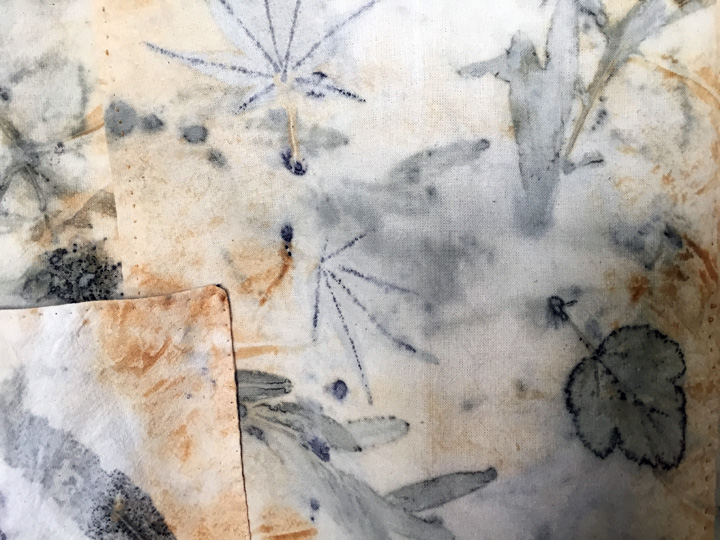
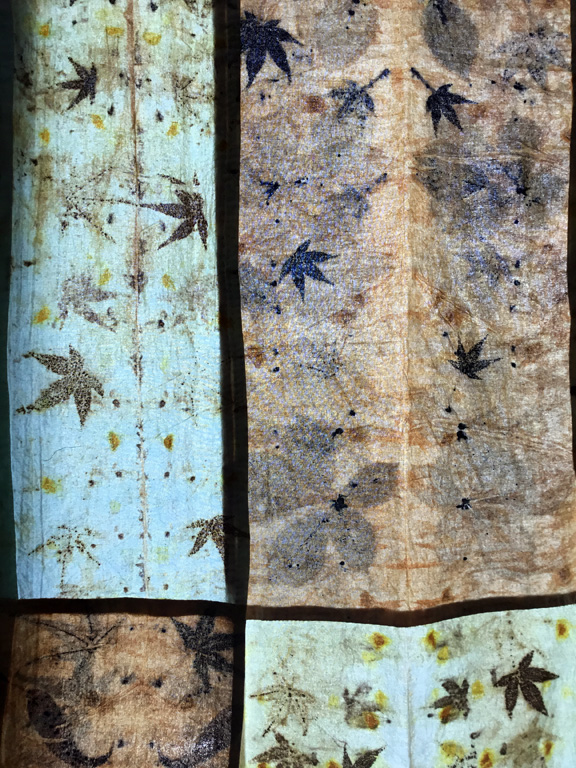
When in doubt or the the throws of depression: eco-dye! This project, a hand-stitched, eco-dyed quilt, involved days of foraging along the shores of Lake Merritt in Oakland, California. The fabric is flour-sack Lito linen towels that I order in bulk from Amazon for both the quality and affordability. The leaves include eucalyptus, Japanese Maple, and rose.


Leaf journal

But first, a word about tools and techniques. I have been using a blank journal — one of many given to me over the years by people who felt the need to proffer a gift but had no idea what to give. I am sure that you, too, have one lying around the house unused. This one has the advantage of a strong elastic cord attached to the journal that keeps it firmly closed when not in use. As I was starting this project I noticed just how unlovely the commercially-designed cover of the journal was. I used Modgepodge, a brown paper bag, and gold paint to transform the unlovely object. It turns out that if you generously slather on the Modgepodge, you can decoupage a leaf collage onto the surface that will endure rough handling.

Journal innards

By keeping a leaf journal, you are able to forage at random all year long, press the leaves, and tap this rich resource whenever the mood for eco-dyeing strikes you.

Now back to the quilt:


The quilt is comprised of two layers of linen. While the top layer features eco-dyed panels, the flip side employs a variety of patterns using bits of raw turmeric root tied or stitched into the cloth, boiled, and removed.

Turmeric panels


In the past I have used long rows of vertical stitching to hold the two sides of a quilt like this together. This time I experimented with stitching around some of the eco-dyed leaves on the top side of the quilt, which produces stitched ghost outlines of leaves on the turmeric-dyed side.

Stitched leaf silhouette

Look closely to see stitched border on leaves

Making a quilt like this — from the ambling walks to forage for leaves to the slow, mesmerizing practice of hand-stitching — is one of the best ways I know to tune in to the universe and be here now.

Friday, April 1, 2022

Spontaneous Stitching: Spirit Cloth


This piece is the result of itchy fingers and an overwhelming urge. It combines scraps of eco-dyed fabric, fabric printed with pounded flowers, and fabric from random projects. The scraps are connected using sashiko stitching, and some are hand-stamped with my current thoughts regarding the meaning of life, death, and the universe. It is 3 inches wide and 21.5 feet long.

I have no idea what it is.


A friend came over when it was close to completion and after fingering it thoughtfully said, "This would be perfect for wrapping a dead body." In the past she created a tasteful shroud for her own mother, so in my immediate crowd she is certainly the expert on such matters. It is an idea rife with possibilities. I pictured hearing of a death and then discretely sending them a lovely small bundle of spirit cloth (see first photo above).


My own vision, as I stitched away until the scraps ran out, was to drape it artfully over the branches of some large piece of gnarly, picturesque driftwood on the beach and set it alight. My 10-year-old grandniece was so horrified by this idea that I dropped it, at least temporarily, out of consideration for her sensibilities.


So currently it hangs in my dining room from vintage French wood sewing spools while it awaits its ultimate, unknown fate.


Thursday, March 24, 2022

Eco Dyeing Mania #2: Hyper-Local Couture


Test-dyeing to see what works

Hyper-Local Couture


The ongoing experiments with eco-dyeing and the heightened focus on my own limited environs during the pandemic led to this concept of hyper-local couture. Hyper-local couture is clothing made from recycled natural fabrics and eco-dyed using plants that can be found in the immediate neighborhood of the wearer.

The Lake Merritt Top


The Lake Merritt top is comprised of scraps of fabric dyed using plants foraged during walks around my neighborhood. By the time I made the top I was well versed in which plants would work, and used copper and iron mordants to vary the colors of both the cloth background and the plant prints. Copper gives a greenish yellow tone while iron offers a rich, earthy, reddish-brown to black tone.

Lake Merritt shirt: front

Detail

Back

Detail

Me wearing the Lake Merritt shirt

The Northeastern Connecticut Top

This next top emerged from an ad hoc eco-dyeing workshop I offered to a few friends at a lovely rambling house in northeastern Connecticut with equally lovely rambling grounds bursting with foliage — much of which I was unfamiliar with. As a result, the first part of the workshop involved foraging and testing plants and trying to figure out which plants lent themselves to eco-dyeing (see top photo in this post).

All participants, including myself, walked away with pieces of eco-dyed fabric. What better way to say thank you for a wonderful interlude in the Connecticut countryside than to use those scraps of fabric to create a piece of hyper-local couture for the hostess, based entirely on plants found in her own backyard.

Connecticut shirt: front view

Detail

Detail: lining from recycled men's shirt

Back

Detail

Modeling the shirt before sending it off

For more about ongoing eco-dyeing mania and some helpful how-to links, see Eco Dyeing Mania Part One. 

Tuesday, March 22, 2022

Eco Dyeing Mania - Part One


Foraged leaves and bundling sticks

One strategy I have been relying on heavily to survive the Covid-19 pandemic is eco-dyeing - a practice tailor-made for plague times. During the height of the pandemic I was essentially restricted to roaming my walkable neighborhood near Lake Merritt in Oakland, and once home I found myself with plenty of time on my hands and no visitors in site. I used those walks to forage for leaves and the time at home to experiment, and two years in there is barely a textile surface in my house left untouched by eco-dyed prints. I will be sharing those over the next few posts, but in response to requests I am including in this first post a couple of handy eco-dye how-to links. 

How-To Sources

Just click on the headline of the source to reach the link.

India Flint: The goddess of eco-dyeing and author of the book Eco Colour (Murdoch Press, 2008). A great grounding in techniques and possibilities.

Dye Plants: Figuring out which plants have leaves that produce strong, crisp prints can be an ongoing experimental process, or you look for a little help. This link is a guide to dye plants in North America complete with photographs of both the plant and the dye print they produce. Look for the plants that grow in your neighborhood. And do experiment on your own as well.

Mordants: The key to successful eco-dyeing, this link offers clear-cut, simple instructions on how to create both a copper and an iron mordant (you get different colors and results depending on which you use).

Sample Works: Household Textiles


Pillows

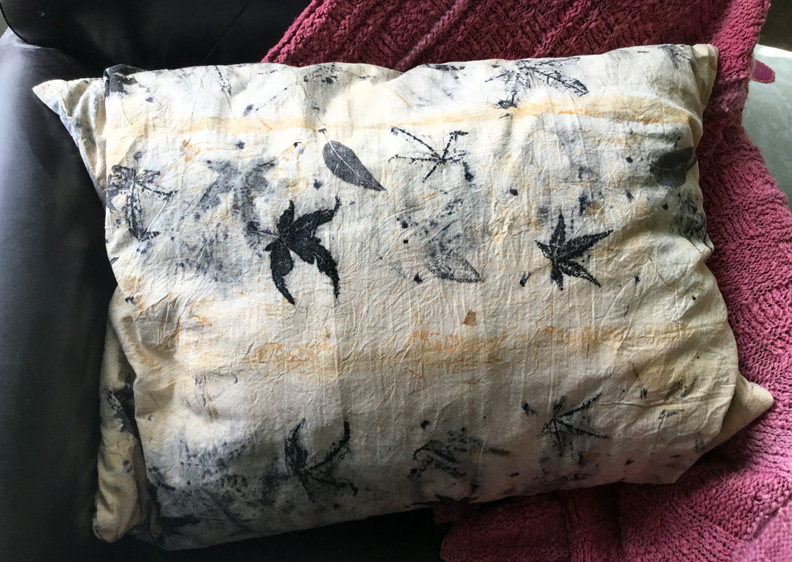
Here is a gallery of pillows created during the pandemic via eco-dyeing.

Pillow One

Pillow One Reverse


Pillow Two


Pillow Two Reverse

Pillow Three

Pillow Three Reverse

Pillow Four

Pillow Four Reverse

Curtains

These eco-dyed curtains use a magnetic fastening system I invented. Little magnets are sewn into the top edge of the curtain, and metal washers have been fastened to the window edge using removable museum wax. These bay windows look out on Lake Merritt and most of the time I want the view unobstructed. However, at night when guests sleep on the front daybed, or when I would like an afternoon nap, this system allows me to put curtains up in seconds, and then take them down again even more quickly.

The curtain storage box

The curtains in a lovely jumble

Small magnets sewn into top curtain edge

Corresponding metal washers on window ledge

Curtains hung in bay windows

Closer view

Detail view

Detail view

Detail view

Bonus

And here is a throw-away bonus: a photo of a cloth throw in progress which was gifted away before I had a chance to further document the item.

Eco-dyed throw in progress

Stay tuned for one more post related to eco-dyeing which focuses on hyper-local couture.

Sunday, March 13, 2022

Fiddling with Scraps: The Roots Book


Accordion book, 3 3/4" x 4"

Fashioned from an assortment of scraps from the Roots Project and two years of pandemic eco-dyeing, this little Roots book combines sashiko stitching, eco-dyed scraps from foliage within a one-mile radius, and the roots of native grasses. Enjoy - I know I did.

Back of book


Inside


Outside


Close-up

Close-up

Close-up


Close-up


Close-up


The creative surprise? How easy it turned out to be to appliqué the dried native grass roots to the cloth using teensy tiny anchoring stitches.

Related Posts with Thumbnails