Showing posts with label crystallization. Show all posts

Friday, April 24, 2015

Specimens: A Crystalized Assemblage


Specimen jar

Experiments in crystallization continue with the Specimen Jar, an assemblage of stitched leaves, mussel and scallop shells and a few feathers, all crystallized and arranged in a jar, the leaves floating in mid-air with the aid of a little magician's thread. For techniques and how-to's, delve back through the category titled "Crystallization" on this blog.

Crystallized feather

Close-up

Spiral stitched leaf

Spine and border stitched leaf

Spiral leaf no. 2

Rib-stitched leaf

Shells and feathers

Jar interior

Jar interior

Tuesday, July 22, 2014

Ossified Fairy Wings


Woodland specimens

As recorded earlier in this blog, a little-known fact has recently come to light, supported by the evidence documented on these pages: Fairies regularly shed their wings just as snakes shed their skins. It is theorized, though not proven, that this occurs during change of seasons from winter to spring. Once shed, the wings ossify and crystallize. See the prime specimen below.


Hanging wings: front

Hanging wings: back

The final photo below shows the wings held in a hand to give a sense of scale. If you're curious about how this was done and would like formulas and how-to information see Crystallization.

A wing in the hand is worth two fairies in the bush.

Saturday, July 19, 2014

Crystallization: Ossified Fairy Dress


Who knew that fairies shed their dresses and wings just like snakes shed their skins? Careful searching of a forest floor may lead to the discovery of a little ossified ballgown like the one above.

In this case the ossified gown has been replicated with a little human help and a supersaturated solution of 3 tablespoons 20 Mule Team Borax per cup of boiling water. The first step: create a diminutive ballgown out of scraps of linen.


Next step: immerse the gown in the supersaturated borax solution and let sit for a few hours (this crystallization process took just three hours—apparently borax crystals love linen).

In suspension

Suspension from above: a toothpick through the shoulder loops, hung by a piece of thread from a wooden skewer.


Drying, suspended from a corner over the kitchen sink

The finished gown, now weighing about a pound and able to stand on its own

A fairy gown in the hand...

Or hung on the wall

Sunday, July 13, 2014

Crystallization Experiment #4: Shells and Rocks


Crystallized rock and seashells

Here are some odds and ends from earlier crystallization experiments (see Crystallization for earlier experiments with books, photos, and eyeglasses). I think the point here is that you can crystallize absolutely anything and the question is: What would look far more interesting if it was crystallized? I already have my next experiment in mind...stay tuned.

Once again the formula used is 3 tablespoons 20 Mule Team Borax (available in any supermarket) to one cup boiling water. Stir to create a supersaturated solution, immerse your object, and walk away. You'll have stunning crystals in less than a day.

Crystallized rock

If you're like me you tend to pick stuff up when  you're wandering along the seashore. Once you get home you empty your pockets and end up with shells and rocks scattered here and there throughout your house. Now you can crystallize them and while they will still just be a bunch of crap lying around your house, they will be very, very interesting and mysterious crap.

Crystals following their own path along a seam in the rock

Close-up

Scallop shell with gorgeous crystals

Close-up: gorgeously fat borax crystals

Clam shell sporting a spill of crystals

Close-up

The end.

Tuesday, May 27, 2014

Crystallization Experiments #3: Photos


Vintage photo with alum crystals

The final experiment for now with crystallization before moving back to textiles (which, by the way, do NOT crystallize well). To see earlier experiments see Crystallization Experiments 1: Books and Paper Ephemera, and Crystallization Experiments 2: Reading Glass Curtains.

Photo in supersaturated Borax solution

I half expected photos to simply dissolve or to have the images become muddied when immersing them in supersaturated solutions but not so. In fact the reverse is true; crystallization seems to seal and preserve the photos, particularly the Borax crystals.

The formula again involves 3 tablespoons of 20 Mule Team Borax per cup of boiling water, stirring to dissolve and create a supersaturated solution. Immerse the photo and wait for crystals to attach. The photo here (taken circa 1973 and printed by a drugstore photo service) was immersed for about a day. It is now rigid and covered in crystals.

Self portrait: photograph encrusted with Borax crystals

Close-up

The next photo, taken of my mother standing in the garden in Stone Mountain, Georgia circa 1949 or so, is also a commercially printed snapshot. This photo was immersed in an alum crystal solution (1/2 cup boiling water and 2.5 tablespoons alum), which forms much larger crystals, for about 24 hours.

Frozen hope: photo encrusted with alum crystals

Close-up

The final experiment involves a photo circa 1910 or so, developed on an uncoated paper much thinner than the photographic paper used today. I left it in a supersaturated alum solution for a few hours. It crystallized nicely but once out of the bath and drying, the crystals began to fall off. As a result the end result shown below is a bit of a cheat. I glued crystals back on, which enabled me to strategically place them where I wanted to. However, in the close-up below you can see that hundreds of miniscule little crystals are adhering to the photo paper on their own.

A Moment in 1910: photo with alum crystals

Close-up

How do you frame a crystallized photo? Find an old frame, remove the glass, and glue the photo directly to the frame backing. Here, both frame and backing were wood, which worked out well aesthetically.

Framed crystallized photo

 After viewing these experiments, a friend is planning to dip one-page programs for a memorial service for her mother in a Borax crystal solution. The possibilities are endless. The "frozen memories" metaphor is fairly compelling. Have fun experimenting on your own.

Wednesday, May 21, 2014

Crystallization Experiments 2: Reading Glass Curtain


Crystallized reading glasses

Kitchen curtain featuring crystallized reading glasses

The second in a series of crystallization experiments. For the formula on a dead-easy way to make crystals using 20 Mule Team Borax see Crystallization Experiment 1. Once you realize crystals can grow on objects, you start scavenging around your studio for interesting stuff to plop into the supersaturated crystal solution. This time around: reading glasses.

I know I'm not the only person who has the stem break off their reading glasses. In the past I've created another version of reading glass curtains by gluing old photo negatives over the lenses (see Eyeglass Curtains). They look fabulous but it turns out the negatives fade over time in the sun.

Reading glasses in Borax solution (note highly technical manipulation with chopstick)

After about 24 hours in a super saturated Borax solution I achieved the following results.

Crystal encrusted glasses

Close-up

Crystal-encrusted glasses

Attached to curtain with small wire at nose bridge

Close-up

And yes, this was an add-on to these curtains, which had already been embellished with pockets containing seaglass and shards of plastic ginger ale bottles (see Seaglass + Recycled Bottles = Plastic Fantastic Curtains).


Sunday, May 18, 2014

Crystallization Experiments 1: Books and Paper Ephemera


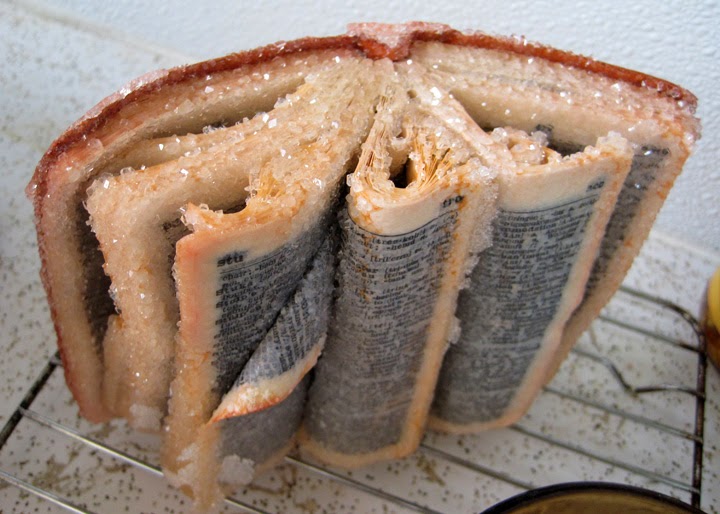
Crystallized German-English Dictionary

Interest in crystallization was piqued by a maker studio tour in San Francisco, during which I saw artist Alexis Arnold's crystallized books made using 20 Mule Team Borax. They were enchanting and I wanted to know how it was done, but she was charging $400 for a how-to workshop. Upon googling after arriving home I found that the 20 Mule Team Borax website offers the dead-simple instructions for growing crystals absolutely free, and a box of Borax from the local supermarket costs less than $6.

The formula:
- Use a glass or porcelain container large enough to immerse whatever object you want to crystallize.
- Boil water, and make a super saturated solution in your container using 1 cup boiled water per 3 tablespoons Borax.
- Immerse object (and in the case of the book, arrange pages using chopsticks) and wait for crystals to grow.
- When you think it's crystallized enough, remove from solution and dry on drying rack. The book shown took less than 24 hours.

Crystallized book on drying rack

The end result is a fixed object - crystallized and surprisingly heavy.

Crystallized book

Close-up

After crystallizing a book I began to wonder what other objects I could crystallize. Succumbing to my fondness for creating little shoes out of an infinite range of materials (see All My Little Shoes), I tried crystallizing a hand-stitched paper shoe.

Crystallized paper shoe

Side view

Then it occurred to me to experiment with collage. Turns out you can create a collage using a glue stick, immerse it in a super saturated Borax solution minutes later, and the crystals seal in the collage. The assemblage/collage below includes a booklet on the alchemy of quinte essence I got in India about forty years ago, a visa snapshot of me from the same era, and tucked into the booklet a scrap of Bharatanatyam dance notation I was studying at the time.  Now they're all a frozen memory.

Crystallized assemblage

Close-up of visa photo

The explorations did not end there. Stay tuned for more experiments in which I start crystallizing everything in sight.

Related Posts with Thumbnails